 ALEX FANTINIart · discipline · knowledge
The LEGO box: from understanding principles to the birth of Tres, Tres
Alessandro Fantini’s journey. A story of research, experimentation and the development of Latosa Escrima principles.
Estimated reading time · 16 min
In this article
The LEGO Box
Today I want to tell you a story. It began many years ago, when I started studying, experimenting with and exploring the principles and concepts of Latosa Escrima through the teachings of my masters: René Latosa, Bernd Schubert, Bill Newman and Marcus Bartolomé.
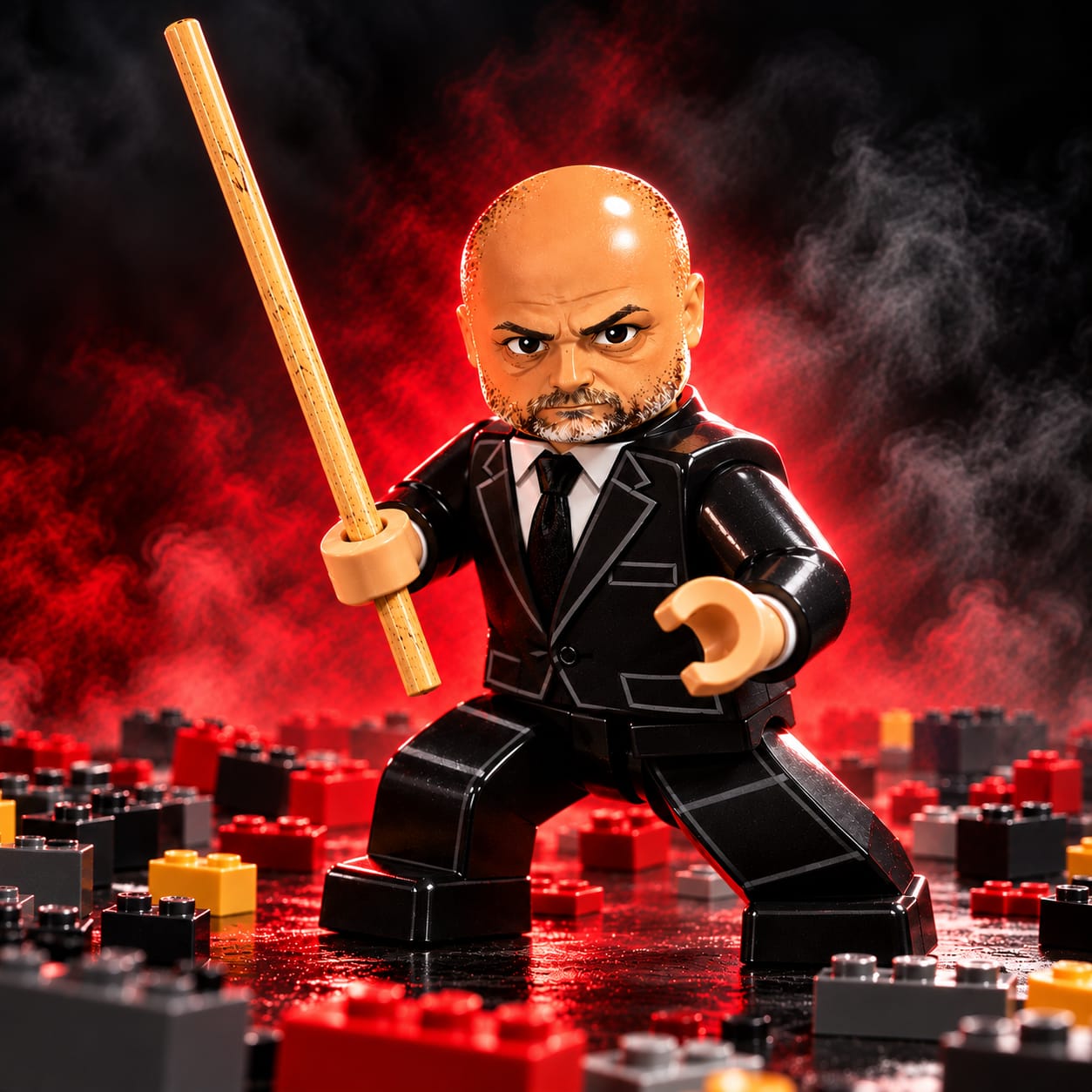
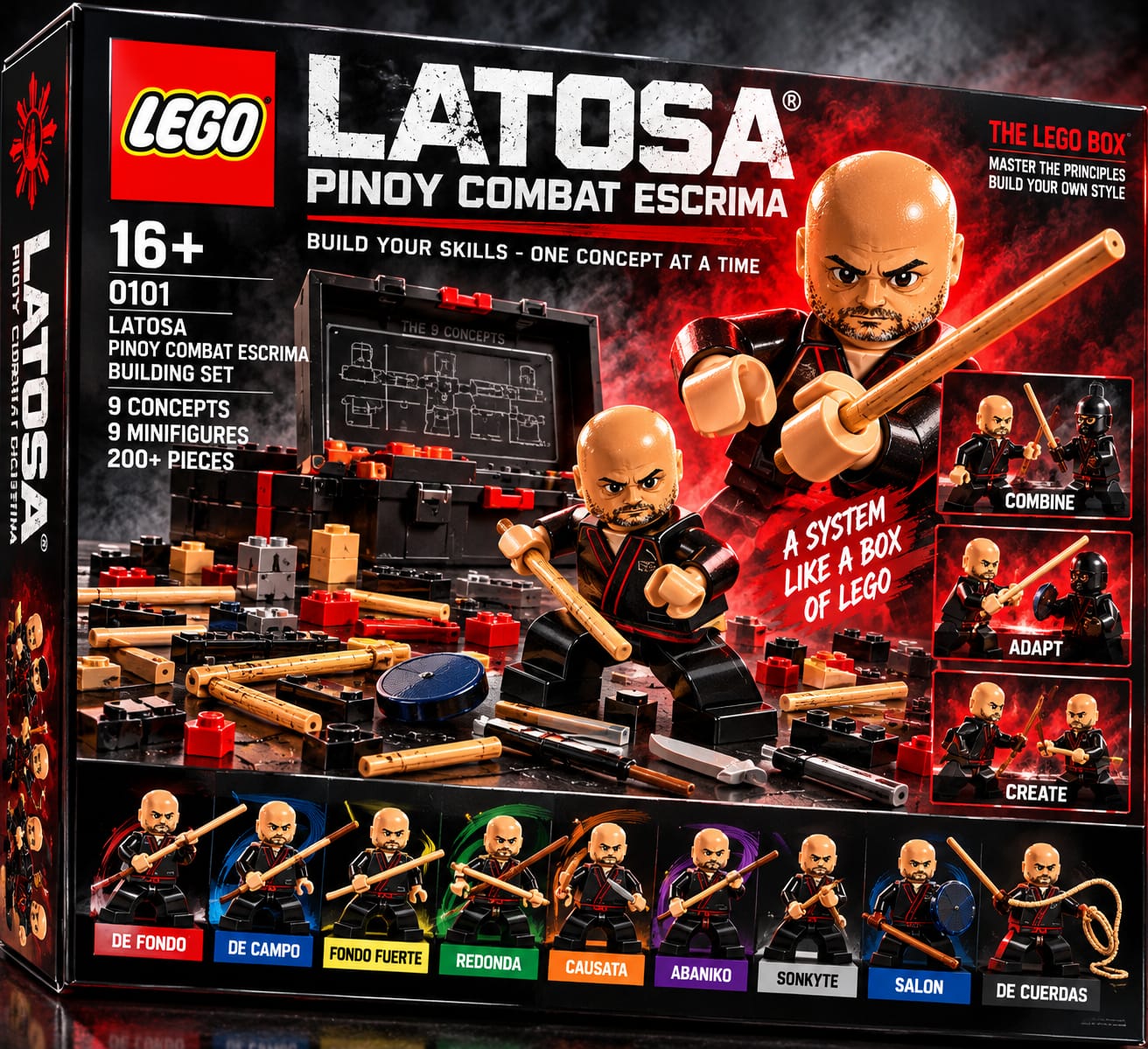
During those early years I realized something fundamental: the principles of Latosa Escrima could be combined without losing their individual identity. It was like having a large box of LEGO bricks in front of me. Each brick had its own color, shape, size and purpose. Alone it was just one element, not yet a complete construction. Once you learned to recognize its characteristics and connect it with others, however, you could build a house, a bridge, a tower or a fortress. It all depended on understanding how to use the pieces.
For me, Latosa Escrima worked in precisely this way. René Latosa did not merely teach a collection of techniques to be reproduced mechanically. Through movement he demonstrated principles and concepts that students had to learn to recognize, understand and apply. The distinction was crucial: understand a principle and you can develop it; copy only the movement and you remain confined to its form.
That realization gradually changed the way I studied. I did not want simply to repeat what I had seen in a lesson or seminar. I wanted to know why a movement worked, under which conditions it could be used and how it connected to other elements of the system. I began establishing my own basis for research and laying the first bricks upon it. One concept led to another; one movement generated a second; one solution might become another, depending on distance, timing, angle and the opponent’s response. Little by little I was building a personal fortress — not a fixed, closed structure, but one that experience could enlarge, change and adapt.
Understanding principles rather than collecting techniques
Over the years I learned that knowing many techniques did not necessarily mean knowing how to fight. A technique may be performed correctly during a drill without being applicable when an opponent reacts, changes distance, alters the timing or tries to strike you.
I therefore increasingly concentrated on fundamental principles. Power, speed, timing, balance, distance, control, concentration and attitude were not isolated elements. They belonged to a single structure, while a technique was only one possible expression of those principles. My aim was to understand how the structure functioned, not to memorize an ever-growing number of movements.
I experimented with different combinations to see how the concepts of Latosa Escrima might flow into one another. Each new combination needed a reason. I had no interest in adding movements merely to make the system more complicated; instead, I tried to remove what seemed superfluous and retain what could be of practical use. To me, the evolution of a martial system is not a matter of continually adding techniques, but of understanding its underlying principles more deeply.
The birth of Tres, Tres
My Tres, Tres was born from this long process of study and experimentation. I never conceived it as a system intended to replace Latosa Escrima. It was my own way of organizing and interpreting the principles I had learned.
In the course of my research I worked on the relationships among nine concepts: De Fondo, De Campo, Fondo Fuerte, Redonda, Crusada, Abaniko, Sonkite, Saloon and De Cuerdas. They were not nine separate compartments but nine possibilities that could connect, overlap and change during combat. An action might begin with one concept and develop through another, depending on the situation.
Tres, Tres grew from the need to organize these connections into a structure that would help practitioners understand the possibilities of movement rather than simply reproduce predetermined sequences. The LEGO metaphor returned: the bricks were those my masters had given me, and the construction was the outcome of my research.

Experimentation and confrontation
Over the years I tried to test my studies through encounters with practitioners and fighters from different martial backgrounds. I wanted to see how the principles of Latosa Escrima responded to people who did not necessarily use the same techniques, distances or strategies.
This kind of confrontation helped me recognize both the possibilities and the limitations of particular applications. A movement that works perfectly with a cooperative partner may be far harder to perform against resistance. I therefore consider it essential to distinguish technical demonstration from experimentation in combat. Both have a teaching role, but they do not provide the same information: a demonstration illustrates a principle, while a dynamic confrontation shows how that principle behaves when conditions change.
Experience beyond the training hall
An important part of my personal experience developed outside martial arts. In my professional life I worked as a contractor, dealing with situations and environments in which risk perception, judgment and control of my own reactions had concrete meaning.
These experiences strongly influenced my understanding of self-defense. In a training hall we may know our opponent, agree on the rules and stop the exercise when necessary. Beyond that environment, conditions can be unpredictable. That is why I place such importance on recognizing danger, managing distance, remaining clear-headed and making decisions under pressure.
I do not regard my professional background as automatic proof of the effectiveness of any martial technique. Rather, it was one of the experiences that directed my research toward simplicity, adaptability and the management of unforeseen situations.
Full-contact combat
Another important part of my experimentation has involved full-contact combat, including experiences with protective equipment and armor used in historical combat. These activities allowed me to observe certain principles under genuine opposition.
When an opponent really tries to strike you, your perception of distance, management of time and ability to perform a movement change. Physical and mental pressure can profoundly affect a fighter’s behavior. This is why I have always regarded training simulators and protection as essential tools for a realistic practice, while respecting necessary safety limits.
Of course, sporting or regulated combat cannot reproduce every condition of a real assault. It can, however, test important aspects that rarely emerge through cooperative training alone. This conviction would become one of the central elements of my Academy of Arms.
Rome, 2019: my exchange with René Latosa
In 2019 I had the opportunity to spend time with my Grand Master René Latosa during a visit to Rome. It mattered a great deal to me because I could show him some of the results of my research over the years.
During private training, René asked me to explore two principles I considered fundamental: “To touch without being touched” and “To be within measure without being within the opponent’s measure.” These were essential to my study of fencing. It was not simply about being faster; it was about the relationship between distance, time, trajectory and movement.
I explained that my research included trigonometry applied to fencing, the geometry of footwork and the ballistics of strikes. I distinguished between the line of attack and the angle of attack: the line describes the direction along which an attack develops, whereas the angle is the orientation from which it is delivered. Changing the angle can change offensive and defensive possibilities even when the apparent distance between fighters remains similar.
The same principle can be studied through fencing footwork, advances, retreats and angular movements. I also explained that geometric principles of measure and trajectory appeared in sixteenth-century Italian fencing, particularly in treatises on sword-and-dagger combat.
Connections with European fencing
During our exchange I mentioned a historical connection that interested me. In the seventeenth and eighteenth centuries, under Spanish colonial rule in the Philippines, European fencing traditions came into contact with local fighting practices.
In my interpretation, some Filipino fencing systems may have absorbed principles similar to those of European fencing, particularly in controlling measure and trajectories and striking without being struck. Such knowledge might have entered certain family traditions and been passed down as restricted heritage.
I am not claiming that all Filipino fencing derives from European fencing. I find it valuable to study possible relationships and exchanges over the centuries, distinguishing documented facts from interpretations requiring further research. My interest was in understanding how similar geometric principles could appear in different fencing traditions.
René Latosa’s footwork and American boxing
René gave me an important clarification about his own movement. He told me that alongside Filipino fencing with his teachers, he had also studied American boxing. According to his account, his footwork was almost entirely influenced by boxing, and he put that influence at 99%.
He said that movements arranged in the familiar asterisk pattern also came predominantly from the mechanics of American boxing, and that the same influence could be seen in the structure and dynamics of his strikes.
I found this particularly interesting. René’s work was strongly influenced by boxing; my research explored European fencing footwork, control of measure and angular displacement. I did not necessarily see these interpretations as opposed to one another. They were different ways of organizing movement through common principles.
The cartwheel: my Fondo Fuerte
At one point René asked how I would identify and represent my Tres, Tres. I answered with a simple image: “René, to me what you call Fondo Fuerte is like a cartwheel.”
A cartwheel has three basic elements: a central hub, eight spokes and an outer iron rim. The rim represents my defense — the structure that defines and protects my space of action. The eight spokes represent my lines of attack and directions of movement. Along those lines I can organize angles, change the measure and develop my actions. The hub represents the center of the action, the reference point around which the entire structure is organized.
Then I explained a principle I consider fundamental: “Combat must revolve around me. I must not revolve around combat.”
That sentence summarized an important part of Tres, Tres. I did not want to spend the entire time chasing my opponent’s movements and losing my own organization. I wanted to learn to manage the center of the action, control distance and choose the most favorable directions.
The cartwheel was therefore a geometric model through which to interpret combat. The hub organized the action; the spokes indicated possibilities for movement; the rim formed the defensive structure. Every element was connected to the others.
“Three, Three”
After I showed him my work, René asked if he could use my Tres, Tres. I remember him calling it “Three, Three” in his American pronunciation.
I replied by returning to the metaphor that had accompanied my entire research: “René, you showed me a box of LEGO bricks. All I did was build something different from what was in the instruction manual. To me, Latosa Escrima is a toolbox, a LEGO box: a tool with which you can assemble or disassemble anything.”
It was the simplest way I could explain what I had done. I had not tried to replace the principles he had taught me. I had tried to understand them and use them to develop a personal construction.
René Latosa at my Academy of Arms
During that 2019 visit I also took René to my Academy of Arms. I remember how surprised he was by the quantity and variety of weapons in the room. On the walls hung numerous kampilan, bolo, barong, taming, Filipino shields, spears and other weapons from Philippine fencing traditions. Some were antique or traditional pieces; others were intended for study and training.
Alongside the weapons I had gathered many full-contact training simulators, protective equipment and specialist gear. René looked at everything and asked why I had arranged the room that way.
I replied: “René, because this is an arms room. We do not merely study movements here: we experiment with full-contact combat. We are fencers, and we practise Filipino fencing with the same mentality as a boxer practising boxing or a fighter preparing for physical confrontation. Without suitable simulators and protection, we risk becoming people who can only reproduce movements without ever testing their effectiveness.
“To me, Filipino fencing is also a tool for self-defense. I want to know how I react when an opponent resists, changes distance and really tries to hit me. If I do not study full-contact combat, how can I assess whether what I practise will help me when it is needed?”
That was the philosophy I had tried to develop in my Academy. Technical knowledge was only one part of the process; the other part was experimentation.
The fencing library and European weapons collection
René was also surprised by another aspect of my Academy: the library. Over the years I had collected an extensive range of books on fencing history, including original books from the sixteenth, seventeenth and eighteenth centuries, preserving the teachings and knowledge of fencing masters from the past. The library also included treatises on twentieth-century Italian sabre fencing.
Beside the books stood my collection of European sabres, including both training-room and military sabres. I did not see these objects as mere decorations. They were research tools. The treatises offered insight into the thinking of historical masters, while the sabres allowed direct examination of their construction, differences, balance and possible relationship with the fencing systems for which they had been designed.
René looked at the library, Filipino arms, European sabres and equipment, and eventually said: “Alessandro, this is not just a gym. It is not even just an arms room. This is a real museum!”
I remember those words with great pleasure. I had tried to create a place where preserving history and practical experimentation could coexist: somewhere one could study an old treatise, examine a historical weapon and then deepen an understanding of movement through training. I did not want fencing history to remain only on the pages of books. I wanted to keep studying it through practice.
René watches full-contact combat
During a training session René had the chance to watch some bouts involving two cadets of my Academy. We used appropriate simulators and protection, but the encounters were not choreographed. The fighters resisted each other and tried to apply the principles they had studied under dynamic conditions.
Protection and simulators reduced the risk of injury while allowing us to experience pressure, contact and the opponent’s reactions. I wanted René to see not only the theoretical side of my work but also how we tried to test it. Explaining a principle is one thing; attempting to apply it when an opponent does not cooperate is another.
I do not claim that protected combat perfectly reproduces every condition of a real confrontation. I do believe that it is an essential way of assessing aspects of combat that cannot fully emerge in predetermined drills. That is why I had devoted so much time and so many resources to building my Academy of Arms.
René Latosa’s words
At the end of that experience René addressed words to me that I have never forgotten: “Alessandro, you are not just a practitioner. You are not simply a teacher. You are a Grand Master of Arms. What you have done over all these years is magnificent work. It almost seems as though you have reinvented Latosa Escrima.”
Those words meant a great deal to me. I had never sought to reinvent René’s system or replace what he had taught me. I had tried to understand it as fully as possible. I had studied the principles, experimented with them, compared them with other fencing experiences and explored their possibilities.
European fencing, the geometry of movement, old treatises, historical weapons and full-contact combat had become tools for deepening my understanding of Latosa Escrima. The most important recognition for me was not the title of Grand Master of Arms. It was that René had seen and understood the work I had carried out over the years.
Once again I returned to the LEGO box. I had not changed the essential bricks; I had learned to build something different with them.
The meaning of Legacy
Looking back on that journey today, I believe it is increasingly important to distinguish preserving a tradition from merely repeating its outward forms. Preserving a teaching does not necessarily mean freezing it in place. It means understanding its principles, respecting its origins and passing on its meaning.
Latosa Escrima has provided tools that have accompanied me through much of my life. With them I have developed personal research without forgetting the masters from whom I received the fundamental teachings. Tres, Tres is part of that journey. It does not claim to be the only possible interpretation of Latosa Escrima principles. It is the result of my experience, research and desire to keep experimenting.
I believe students must recognize the value of the teachings they receive while developing the ability to think independently. A teacher can indicate a direction, show a principle and correct a movement, but cannot replace the student’s personal understanding.
That responsibility becomes even more important when passing on a martial heritage. For me, contributing to the Latosa Escrima Legacy in Europe means preserving the teachings I received while encouraging serious, thoughtful study open to experimentation. It means distinguishing fundamental principles from personal interpretations, respecting history without turning it into something immobile, and remembering that no title, rank or recognition can replace knowledge, practice and the ability to teach.
The construction continues
After so many years of research, my vision of Latosa Escrima remains tied to the image that accompanied me from the beginning: a large LEGO box. Every principle is a brick. Every experience can teach us something about how to use it. Every encounter can reveal a connection we had not previously recognized.
A construction can be enlarged, modified or even dismantled to understand its structure better. But it all begins with knowing the fundamental elements. This is the lesson I have tried to carry forward through my journey.
The teacher can show you the bricks. But learning to build is up to you.
Alessandro Fantini
LATOSA® PINOY COMBAT ESCRIMA
LEGACY EUROPE