 ALEX FANTINIart · discipline · knowledge
It's a stick not a sword
Estimated reading time · 3 min
In this article
Stick and blade: the question of movement
Today I’m addressing a critical topic that had been hardly approached by filipino martial arts enthusiasts and European stick fighters, namely the ortho-physio mechanics of joint movements of the wrist, elbow and shoulder. The habit of confusing the angles on the orthogonal plane created by the cutting lines typical of the brandishing of cutting weapons… compared with the angles [still on the orthogonal plane] typical of the percussion lines drawn by impact hand-held weapons [I mean: non throwing non pole blunt melee weapons i.e. rattan, kamagong, bahi sticks, thus excluding the frombolas, clubs and flails…] must induce many of us to reflect before completely drifting apart from each other.

This topic is not much debated in the discussion forums or in the gyms and the reason for this, according to my opinion, is both functional and strategic. Here goes the functional reasons:
(a) the stick is displayed in front of the students by certain instructors as if it were a scourge or a fan and not as a simulacrum of a steel weapon;
(b) some teachers are convinced that the ‘rattan’ is both a stick and a sword;
c) the baston is sometimes presented as an impact weapon, yet it is circled as if it were a sword.
Below I will outline the weakness of these teaching approaches by making a premise, then I will explain the strategic reasons for certain behaviors carried out by some teachers.

The tool and its teaching role
In stick practice, distinguish the actual tool from its assigned teaching role. Rattan can teach transferable principles, but its mass, grip and impact differ from a blade. Transfer must therefore be tested rather than assumed.
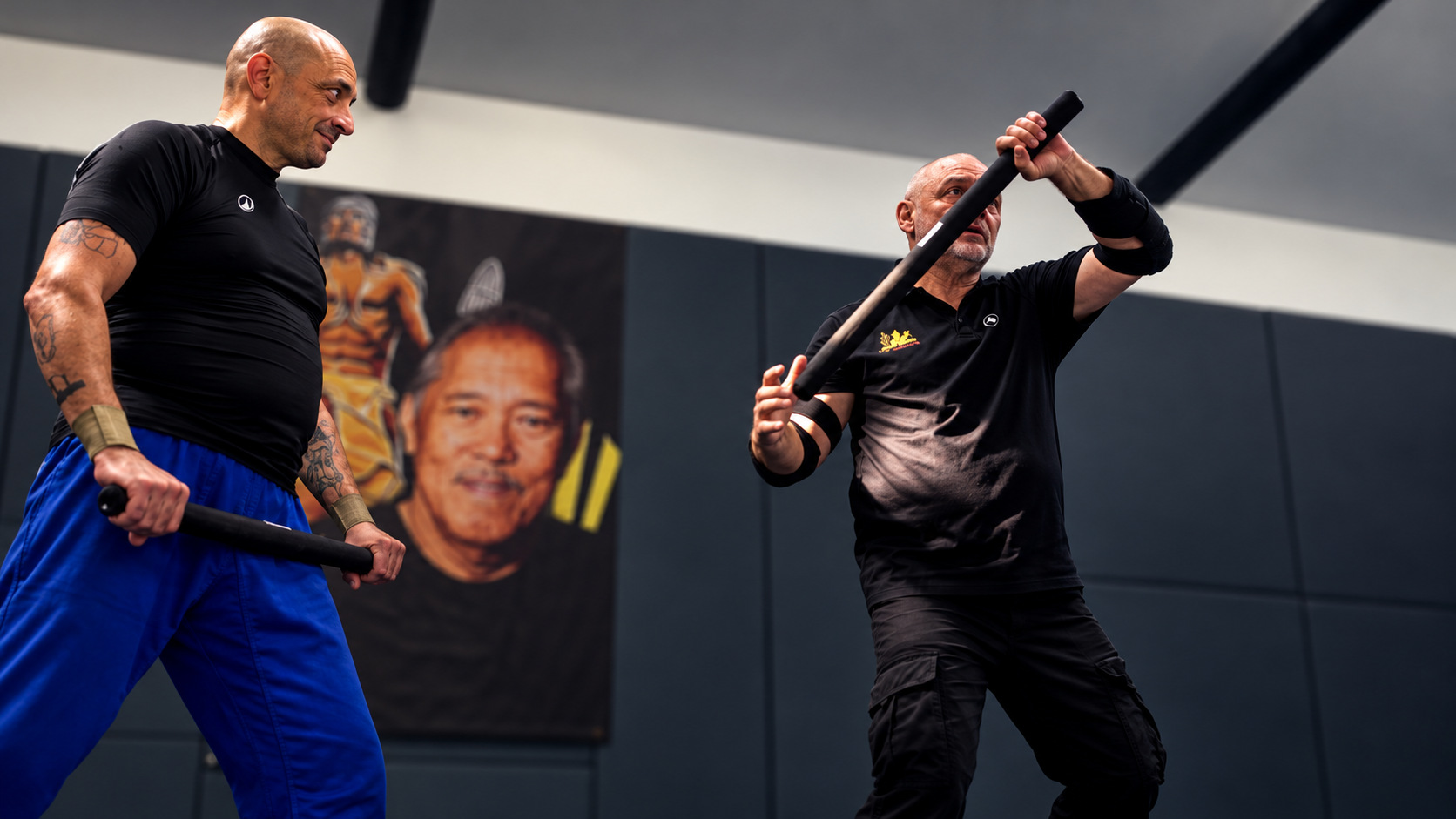
But let us check out the points and go back to the debate.
Control and movement memory
First, control: the speed of a light stick alone does not demonstrate effectiveness. Observe structure, recovery, vibration and grip orientation. If the exercise represents a blade, edge alignment must remain an explicit criterion.
Second, movement memory. Applying a cutting trajectory to a stick does not automatically produce an effective impact; a sequence with light rattan likewise does not by itself reproduce a heavier weapon’s inertia.
Objectives, rules and comparison
Objectives also change practice. Competition, demonstration and fencing study may use different rules and criteria. State the exercise’s purpose and assess distance, timing, control and movement quality within that context.

In Alessandro’s research, opposed practice tests choices and principles: distance management, footwork and response timing. Intensity is adapted to participants’ experience, rules and protection. No result justifies avoidable risk to a partner.
The functional distinction
Now, after all this…where does the functional discrimination lie between the two methods? In my opinion it lies in the confusion of the joint movements of the mechanics of movements. You cannot brandish a stick… you can wave it, or at best you can can wield it ! A stick swooshes through the air, whilst a sword swings and cuts through the air. In other words: only a sword can be brandished!
Sorry folks, but “A stick is a stick… It is not a sword”.
Master Alessandro Fantini (all rights reserved)