 ALEX FANTINIart · discipline · knowledge
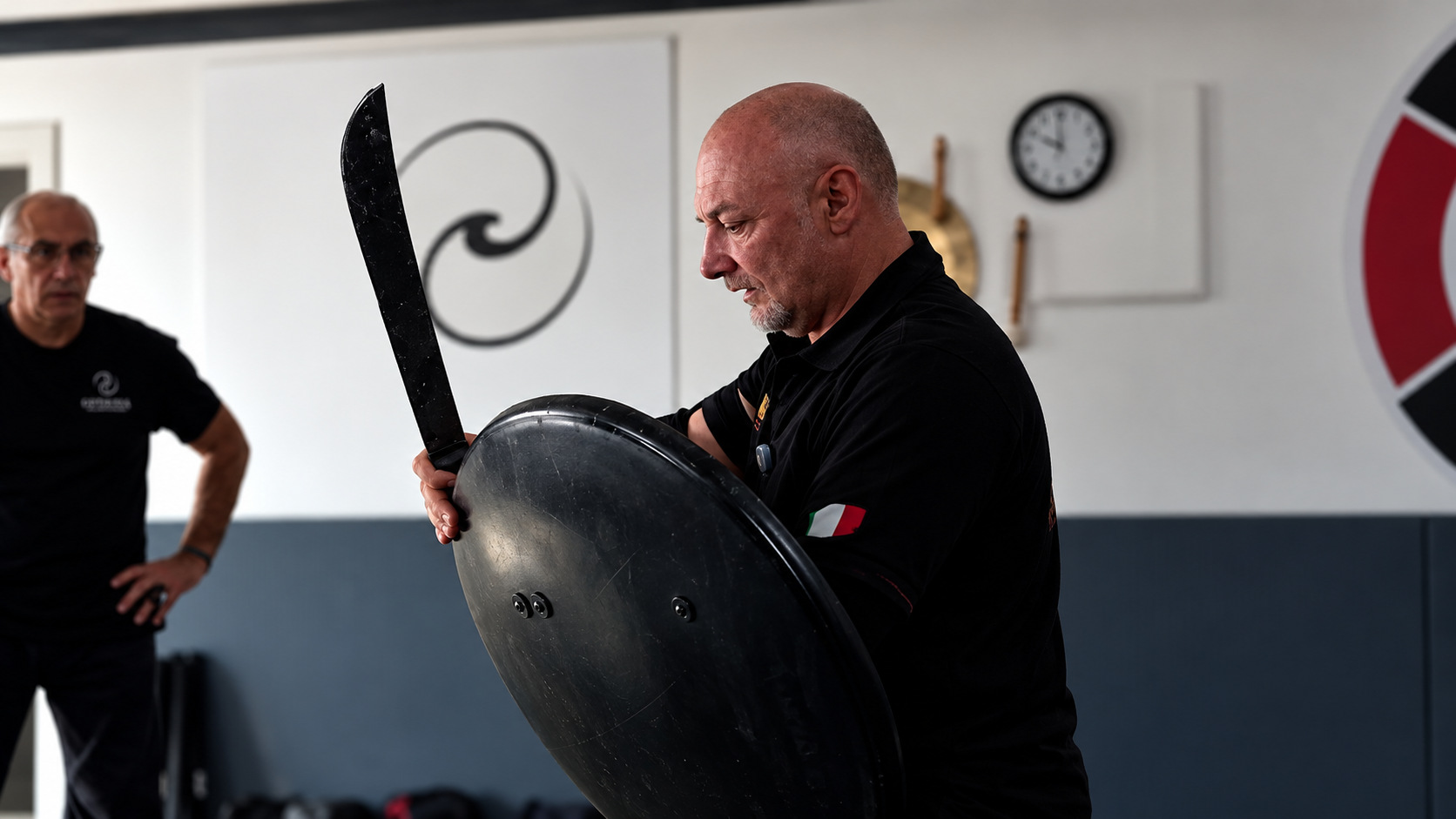
The shield as a weapon
Historical research, martial comparison and full-contact experimentation by Grand Master of Arms Alessandro Fantini
Estimated reading time · 11 min
In this article
INTRODUCTION
Modern imagination tends to see a shield almost exclusively as protection: a surface to shelter behind from an opponent’s attack.
The history of weapons tells a far more complex story.
The shield has been protection, weapon, pressure tool, distance control and a way to create a geometric advantage in combat.
From ancient Europe through Italian Renaissance fencing to Philippine warrior shields, very different combat forms developed solutions based on the same fundamental principle: protecting one line while the other hand strikes.
Grand Master of Arms Alessandro Fantini starts here, comparing historical evidence with modern martial experimentation based on dynamic combat and controlled full contact as well as technical repetition.
The aim is not to reconstruct with absolute certainty what a warrior did centuries ago where sources cannot support it, but to study historical knowledge and test shield principles against pressure, distance, speed and an opponent’s resistance.
FROM THE ANCIENT SHIELD TO A COMBAT SYSTEM
In ancient Europe, shields were fundamental military equipment. They were not necessarily independent: shield, weapon, body position and formation formed a system.
In Greek warfare, the aspis protected a considerable part of the fighter’s body while he mainly used a spear. In Rome, the scutum achieved a different level of integration with military tactics.
The fundamental principle was already clear: the shield must do more than receive a blow. It must change the space available to the opponent.
- line of attack;
- distance;
- angle;
- field of vision;
- response options;
- the opponent’s balance;
- the attacking weapon’s access to the target.
The shield thus becomes part of movement.

THE MIDDLE AGES: THE SHIELD CHANGES WITH COMBAT
Medieval Europe had many geometries: large, kite and triangular shields, targes and small centre-grip shields. Dimensions, materials, grips and relationships with personal armour varied.
There is therefore no single “shield technique”. A large shield changes combat differently from a small one.
Inertia, vision, rotation speed, coverage and support for the weapon change. These are exactly the differences exposed when different geometries are tested under pressure.
THE ITALIAN RENAISSANCE: WHEN THE SHIELD BECOMES FENCING
The Italian Renaissance is especially interesting because much more detailed fencing sources survive.
The surviving edition of theOpera Nova by Antonio Manciolino was printed in 1531, while theOpera Nova by Achille Marozzo appeared in Modena in 1536. The Bolognese School traditions document a fencing environment studying many weapon combinations.
Marozzo covers a vast repertoire including sword with rotella, targe and different bucklers, as well as dagger, polearms and other combinations.
The shield is no longer merely military protection: it becomes part of a true fencing geometry.
A material example shows the real dimensions: the Metropolitan Museum holds a Milanese steel rotella or buckler from around 1570–1580, 55.2 cm in diameter and weighing about 3.9 kg. Another Italian shield at the Met, from 1530–1550, is 59.7 cm across and made of wood, leather and other materials.
These details matter because they show how imprecise “Renaissance shield” is as a general label. Size, weight and construction profoundly change how the object behaves.
THE SHIELD IN THE PHILIPPINES
The Philippine landscape is different. The archipelago includes distinct warrior cultures and cannot be reduced to a single martial system.
Shields of different shapes and origins were used with spears and cutting weapons. Museum collections still allow us to study original examples.
The Metropolitan Museum holds, for example, an eighteenth–nineteenth-century Philippine Moro shield made from a single wooden board with integrated inner handles. It is about 78.7 cm in diameter and weighs around 2.39 kg.
A second eighteenth–nineteenth-century Moro example is made of wood and rattan, about 76.2 cm across and weighing roughly 3.81 kg.
These objects show that sizeable shields existed in the Philippines and that the relationship between wood, rattan, geometry, weight and grip deserves specific study.
Here a fundamental methodological difference from Renaissance Europe appears. For Italian fencing we have treatises describing technical systems; for many Philippine shield traditions, the evidence is mainly objects, iconography, historical and ethnographic documentation.
A modern martial interpretation must therefore not automatically be presented as an assumed historical technique.
EUROPE AND THE PHILIPPINES: TWO PATHS, SHARED PRINCIPLES
Comparison becomes extremely interesting when we stop looking for identical techniques and start comparing identical biomechanical problems.
- How can you see the opponent without exposing yourself?
- How far forward should the shield be?
- How close to the body should it be?
- How can the shield avoid obstructing your own weapon?
- How do you react to an attack from the side?
- How can its edge be used?
- How can the opponent be prevented from controlling the shield?
- How do you fight when distance collapses?
These problems cross cultures and eras. This is precisely where experimentation comes in.
ALESSANDRO FANTINI’S EXPERIMENTAL RESEARCH
Grand Master of Arms Alessandro Fantini takes shield study beyond pure demonstration.
Does a technique still work when the opponent does not cooperate?
To test this, Fantini tried different shield configurations through progressive exercises and controlled full-contact combat with appropriate equipment.
Combat is used experimentally: not to prove a modern simulation perfectly reproduces an ancient battle, but to observe real speed, pressure, feints, successive attacks, angle changes, collisions, fatigue and unpredictability.
EXPERIMENTING WITH DIFFERENT SHIELDS
A particularly interesting aspect compares shields with different geometry, weight and grips. Each variation changes combat.
Small shield
It is quick and allows greater arm mobility, but leaves more body exposed. It needs more accurate trajectory reading and becomes almost a second fencing weapon.
Medium shield
It often offers a useful compromise between mobility and coverage, allowing safer line closure without excessively limiting attack.
Large shield
It offers greater coverage but brings different problems: weight, inertia, visibility, recovery after wide movements and the possibility of the opponent turning the shield into an obstacle for its owner.
This is where combat under pressure is revealing: more protection does not automatically mean greater effectiveness.
THE SHIELD MUST NOT CHASE THE WEAPON
One principle emerging from experimentation concerns the mistake of continually seeking the opponent’s weapon with the shield.
When the shield chases the blow, the opponent can use feints and line changes. The fighter ends up exposing their own target.
A more effective approach is to think in lines and sectors. Stopping the hand is not always necessary: prevent the trajectory reaching its target while creating your own attacking line.
SHIELD AND WEAPON MUST FORM ONE SYSTEM
A second key result concerns coordination. Beginners often think: first block with the shield, then attack with the weapon.
Under pressure this separation causes delay. The more effective solution is to make both halves of the body work together.
The shield closes the line as the weapon enters. Protection and attack become parts of the same action.
THE SHIELD AS AN OFFENSIVE TOOL
Experimentation shows the limits of calling the shield merely “defence”. It can apply pressure, deflect, occupy space, unbalance and control space.
At long distance it mainly protects against trajectories. At medium distance it can interfere with the weapon directly. Close in, it becomes a physical structure between the fighters.
In modern sporting or martial experimentation, all contact must naturally be adapted to protective equipment and safety rules.
THE PROBLEM OF VISION
A large shield protects while also hiding things. This paradox immediately emerges in free combat.
Holding the shield too high may make a direct face strike harder, but also reduce the defender’s ability to read shoulders, weapon and movement.
The effective position therefore does not necessarily offer the largest protected surface. It offers the best balance of coverage, vision, mobility and offensive ability.
FOOTWORK: THE BODY CARRIES THE SHIELD
Another important conclusion in Fantini’s research concerns movement. A shield cannot compensate for poor footwork.
If the fighter stays still, each defence requires a larger shield movement. If the body adjusts the angle correctly, the shield has much less work to do.
Do not simply place the shield between yourself and the weapon. Place your whole body where the shield can dominate that line.
The shield thus becomes inseparable from footwork.
FULL CONTACT AS A LABORATORY
The most modern part uses controlled full contact as a martial laboratory, not to decide who is strongest but to test what survives pressure.
- loss of posture;
- instinctive reactions;
- obstructed vision;
- arm fatigue;
- difficulty recovering a heavy shield;
- weapon–shield collision;
- multiple attacks and sudden line changes;
- difficulty maintaining distance;
- the tendency to hide behind the shield;
- unintentional exposure of the weapon hand;
- loss of coordination between defence and counterattack.
Pressure turns a theoretically possible technique into one testable within the simulation. Modern combat cannot show exactly what happened on a sixteenth-century battlefield, but can reveal which biomechanical solutions withstand opposition better.
FROM HISTORY TO LATOSA COMBAT ESCRIMA
For Fantini, this research naturally meets the principles developed in his study of Latosa Combat Escrima.
This does not mean Italian Renaissance fencing and Philippine warrior arts are the same. That would be historically wrong.
The meeting point is in combat principles: distance, timing, structure, balance, power, angle, positioning and economy of movement.
Introducing a shield does not remove these principles. It changes their form.
The shield becomes a mobile structure for controlling space while the other hand retains offensive ability.
RECONSTRUCTION AND EXPERIMENTATION: THE DIFFERENCE
Modern work must keep a vital distinction: historical sources tell us what can be documented; experimentation tells us what can be tested today.
When the two coincide, the indication is fascinating. When they diverge, the divergence itself becomes a subject of study.
For Fantini, the serious way to approach ancient combat arts is to study objects and treatises, reconstruct equipment, vary weight and dimensions, put on protection, face an unwilling opponent and test.
CONCLUSION — THE SHIELD BECOMES A WEAPON AGAIN
From aspis to scutum, medieval shields to Renaissance rotella and buckler, and traditional Philippine shields, forms change but a universal question remains:
How can I control the opponent’s line while retaining my ability to strike?
Historical research provides part of the answer. Museum objects show dimensions, materials and construction. European Renaissance treatises offer extraordinary technical testimony. Philippine objects reveal how rich and varied the archipelago’s shield heritage was too.
Grand Master of Arms Alessandro Fantini’s experimentation adds a modern question: “What happens when we give the shield movement, pressure and a genuinely resisting opponent again?”
At that point the shield stops being an object hanging on a museum wall.
It regains weight.
It regains inertia.
It occupies space again.
MORE THAN DEFENCE.
AN INTEGRAL PART OF THE WEAPONS SYSTEM.
Grand Master of Arms Alessandro Fantini
Research and experimentation in historical and Filipino shield combat — from sources to testing under pressure.